Charger? I hardly know ‘er!
If you’re new to overlanding—or new to solar power in general—it’s tempting to think solar is simple: panel goes to battery, battery powers your gear. Unfortunately, electricity does not share your optimism.
Connecting a solar panel directly to an auxiliary battery, or simply paralleling your starter and auxiliary batteries, is one of the fastest ways to shorten battery life, damage vehicle electronics, or end up stranded with a dead starter battery in the middle of nowhere. This is precisely why charge controllers exist.
Let’s walk through what a charge controller does, why it’s necessary, and how to choose the right one for your setup, without turning this into an electrical engineering dissertation.
The Problem: Batteries Are Picky (And Solar Panels Are Rude)
Batteries don’t want “power.”
They want very specific voltage and current profiles, delivered in controlled stages.
Solar panels, on the other hand, are blissfully indifferent. In full sun, a “12-volt” solar panel can produce 18–22 volts or even a lot more. Feed that straight into a battery and you risk:
- Overcharging
- Excessive heat
- Permanent capacity loss
- Looking like a dork in front of your friends
- In extreme cases, battery failure or fire
Likewise, directly paralleling your starter and auxiliary batteries means:
- One battery can drain the other
- Different battery chemistries fight each other, and a flawless victory is never how it ends
- Your vehicle’s charging system loses control
A charge controller is the adult in the room—it regulates, limits, and protects everything involved.
What a Charge Controller Actually Does
At a high level, a charge controller:
- Regulates voltage and current from a power source
- Charges batteries in proper stages (bulk, absorption, float)
- Prevents overcharging and backfeeding
- Protects both batteries and vehicle electronics
Without one, you’re trusting thousands of dollars in gear to blind luck.
That’s not an overlanding strategy—it’s a campfire story waiting to happen.
Types of Charge Controllers (And When You Need Each)
Alternator → Auxiliary Battery (DC-DC Chargers)
A DC-DC charger takes power from your vehicle’s alternator (this is essentially the same as the starter battery in terms of the source of power) and safely charges your auxiliary battery.
Why it’s necessary:
- Modern vehicles use “smart” alternators with variable voltage
- Lithium batteries cannot be safely charged directly from most alternators
- Prevents draining your starter battery
Best for:
- Daily driving recharge
- Lithium battery systems
- Auxiliary battery systems without a solar input
- Vehicles with smart alternators
Many overlanders use DC-DC chargers from brands like AnkerSolix, which Mothy Off-Road supports and sells because they’re reliable, well-documented, and field-proven.
Solar → Auxiliary Battery (Solar Charge Controllers)
A solar charge controller regulates voltage from solar panels before it reaches your battery.
There are two main types:
- PWM (Pulse Width Modulation) – simpler, cheaper, less efficient
- MPPT (Maximum Power Point Tracking) – more efficient, especially in variable light, used by cool people
Why it’s necessary:
- Prevents overvoltage from solar panels
- Maximizes energy harvest
- Matches solar output to battery needs
Best for:
- Solar panels
- Stand-alone auxiliary battery systems that are NOT charged from the alternator
- Anyone serious about off-grid power
- Anyone who wants their battery charged and not blown to smithereens
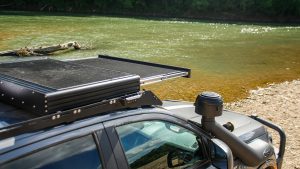
Mothy Solar Racks are designed around specific, known solar panels so we can confidently match panel voltage to MPPT controllers—this avoids mismatches that cause poor performance or controller failure.
Combination Solar + Alternator Chargers
Combination units handle both alternator and solar input in a single device.
Why people love them:
- One box, fewer wires
- Automatic source prioritization
- Clean, compact installs
- Mothy Man uses them in all his builds
- There’s no concern of a DC-DC charger and a solar charge controller conflicting with one another
Best for:
- Minimalist builds
- Limited mounting space
- Users who want simplicity without compromise
These units are especially popular in modern overland rigs and are prominently featured in Mothy Off-Road’s Overlander Level 3+ kits (coming soon!).
Why Pairing Panels, Controllers, and Batteries Matters
This is where many DIY systems go sideways.
Key considerations:
- Panel voltage vs controller input limits
- Controller output vs battery chemistry
- Battery capacity vs charge rate
- What will everyone at Rigs & Coffee think of me if I fail….?
For example:
- An MPPT controller too small for your panel array wastes energy
- A PWM controller will never win you the coveted Coolest Cat at Rigs & Coffee award.
- A controller not programmed for lithium will shorten battery life
- Oversized panels can exceed controller voltage limits
This is why “close enough” doesn’t work in solar.
How Mothy Off-Road Simplifies All of This
We’ve seen too many overlanders:
- Buy mismatched components
- Chase voltage problems for months
- Replace batteries that were killed by bad charging
That’s exactly why we created Overlander Level Kits.
These kits:
- Use compatible Renogy and AnkerSolix components
- Match solar panels, controllers, and batteries correctly
- Are designed to integrate cleanly with Mothy Solar Racks
- Remove guesswork entirely
You don’t need to become an electrical engineer.
You just need a system that was designed on purpose.
The Bottom Line
You need a charge controller because:
- Batteries demand controlled charging
- Solar panels and alternators don’t provide it
- Your vehicle, gear, and safety depend on it
- You’re just not cool without one
A properly designed system lets you:
- Power your gear without running an engine and wrecking the serenity of nature
- Stay off-grid longer
- Protect expensive batteries
- Trust your power when you’re miles from pavement
If you’d like help choosing the right controller—or want a system that’s already been thought through—Mothy Off-Road has you covered.
Because the goal isn’t just power.
It’s staying out longer.